
Abstract:
The latest research by astronomers has found that the energy carried by the strong "black hole wind" generated by supermassive black holes may far exceed past estimates, and its scope of influence can even extend to an area about 300,000 light-years away from the black hole, affecting the entire galaxy cluster environment. This discovery shows that black holes are not just cosmic objects that swallow up surrounding matter. They can also release huge amounts of energy outwards and have a profound impact on the movement of gas far away from the galaxy where they are located.
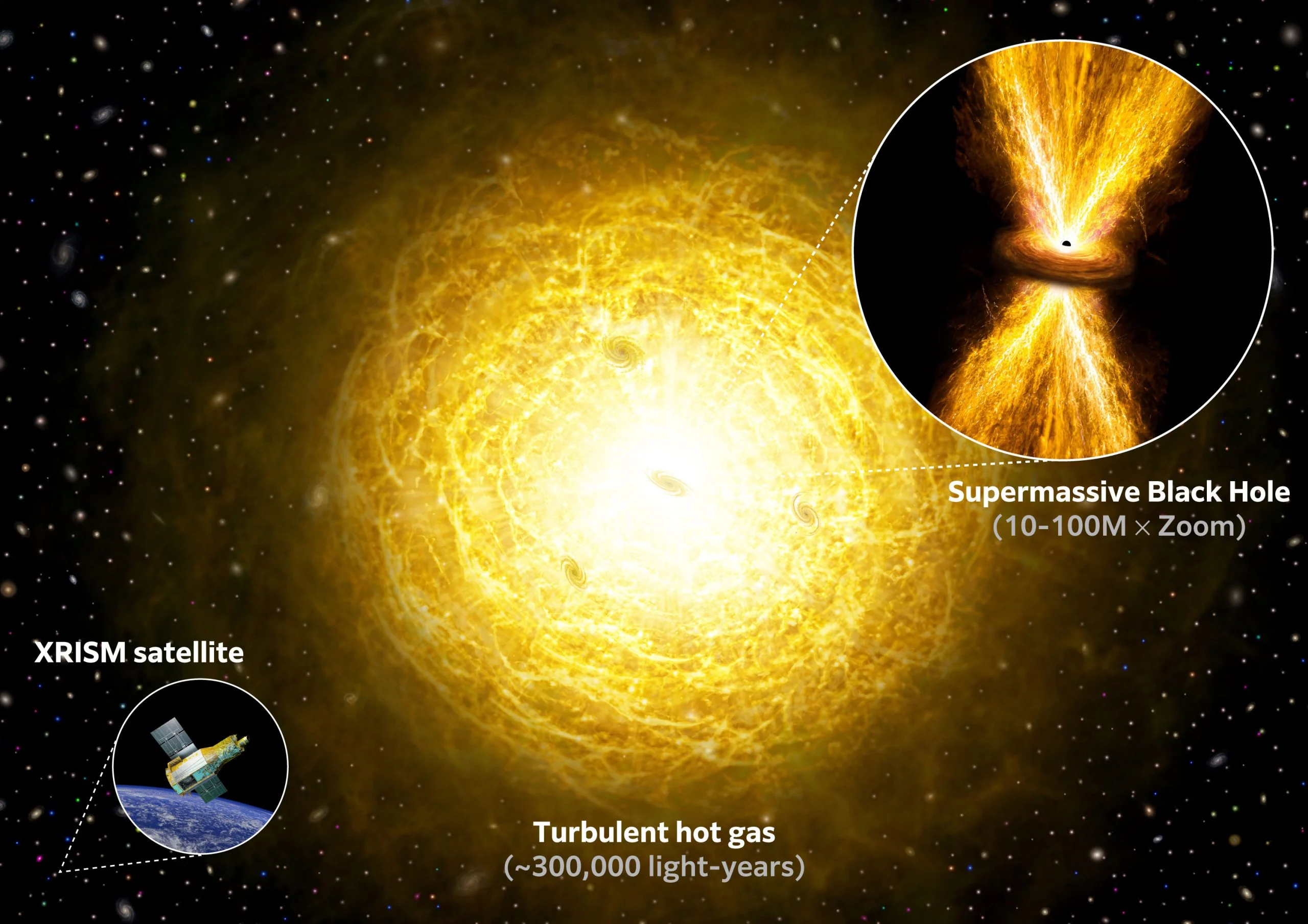
In the past, scientists generally believed that the high-speed gas outflow produced by active supermassive black holes mainly affected the host galaxy where it resides. Because the size of the black hole itself is very small relative to the entire galaxy, astronomers have long believed that this energy feedback is mainly limited to the surroundings of the black hole and within the host galaxy. However, a research team from Tohoku University, Kanazawa University, Tokyo Metropolitan University and other institutions found through new X-ray observations that the situation may be completely different.
Researchers have set their sights on the quasar numbered H1821+643. This celestial body is located in the direction of Draco, about 3.4 billion light-years away from the Earth. It is an extremely bright celestial body driven by a supermassive black hole that is devouring large amounts of gas. H1821+643 does not exist in isolation. It is located at the center of a galaxy cluster, and its core black hole continuously releases energy to the surrounding environment.
The research team used the XRISM (X-ray Imaging and Spectroscopy Mission) satellite launched by the Japan Aerospace Exploration Agency in 2023 to observe H1821+643 and the high-temperature gas around it. XRISM has extremely high X-ray spectral resolution and can determine the speed of gas movement and the degree of turbulence by analyzing the X-ray spectral lines produced by ionized iron ions in high-temperature gases.
Researchers found that the high-temperature gas around the black hole is not in a static state, but exhibits very violent turbulent motion. This motion is not limited to the interior of the host galaxy where the black hole is located, but extends to an area about 300,000 light-years away from the black hole, far beyond the scale of a single galaxy.
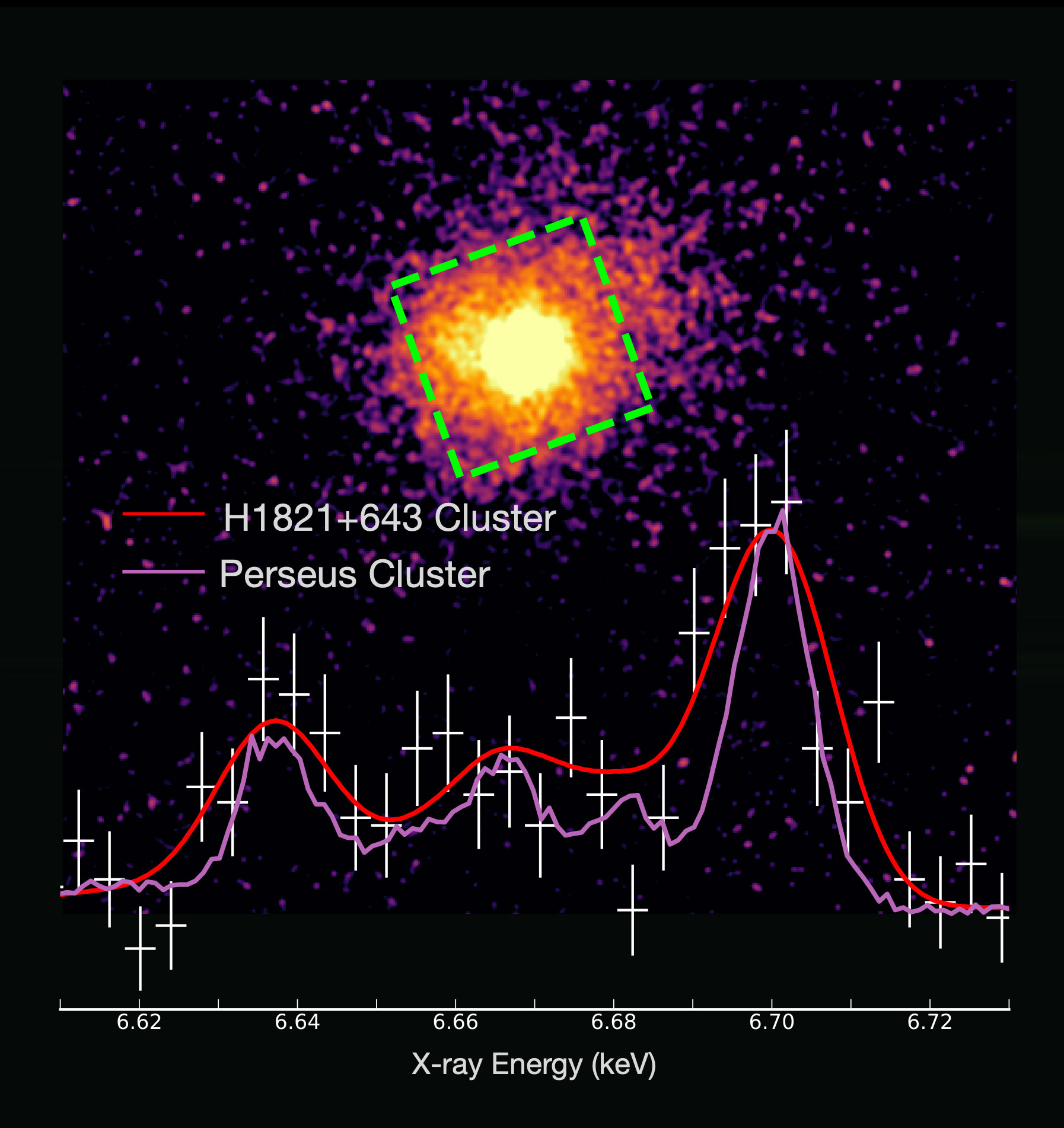
Judging from the observation results, the energy released by the black hole spreads outward through a strong gas outflow and continues to stir the surrounding high-temperature gas. The researchers calculated that the energy carried by these turbulences is about 100 times greater than previous estimates, and its total energy is equivalent to the energy released by billions of supernova explosions.
Satoshi Yamada, the first author of the study and an assistant professor at the Institute of Interdisciplinary Frontier Science at Tohoku University, said that people are usually more familiar with the "swallowing" aspect of black holes, but while accreting gas, black holes also eject gas and energy outward in the form of strong "winds." In the past, it was thought that this wind was mainly confined to the interior of the host galaxy, but this study shows that its actual power is far greater than previously understood and can affect the wider cosmic environment.
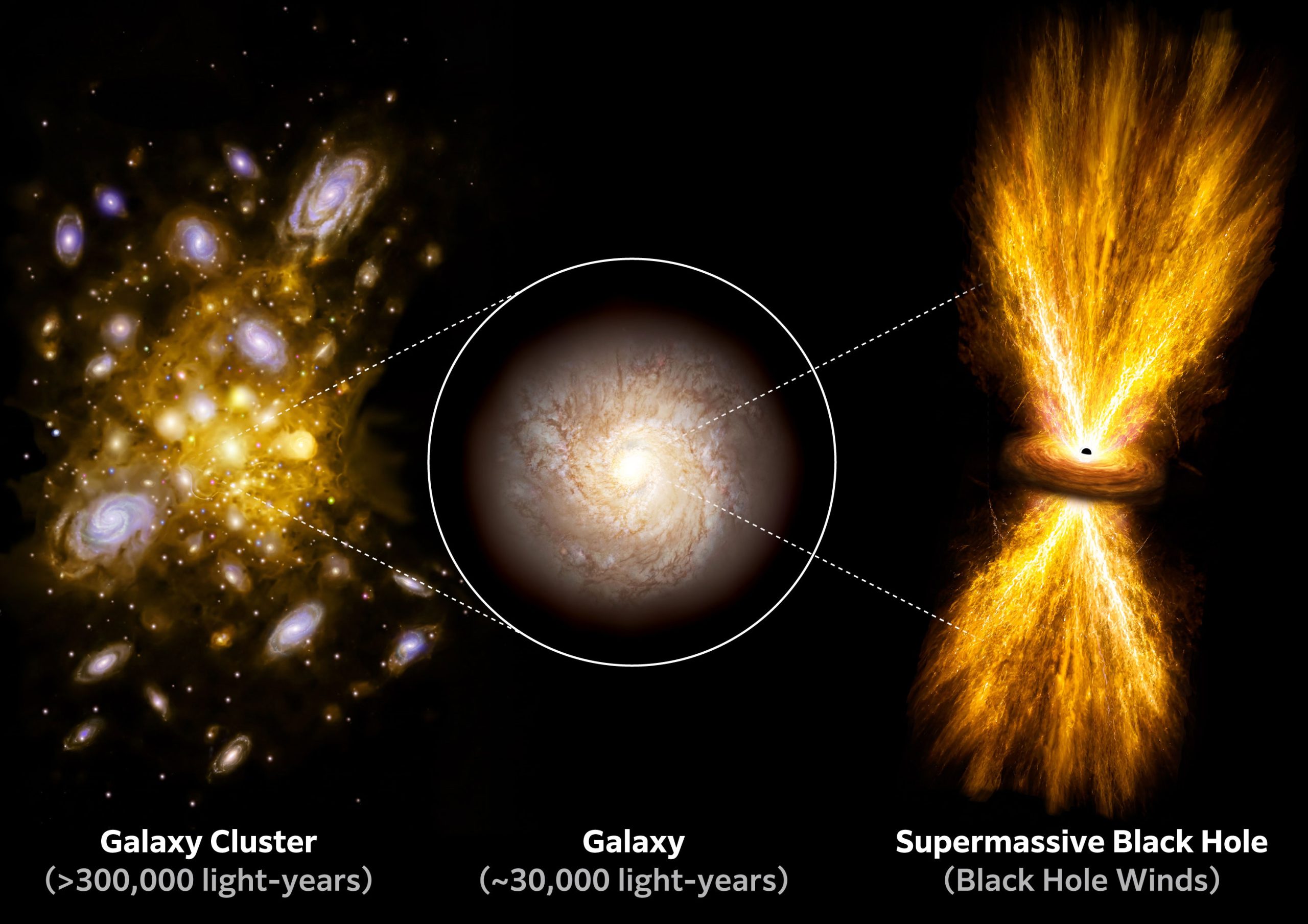
This phenomenon is of great significance for understanding the evolution of galaxies and galaxy clusters. Although supermassive black holes are extremely small compared to galaxies, the energy they release can drive large-scale gas motions. The movement of high-temperature gas will affect the distribution, temperature and energy circulation of matter around the galaxy. Therefore, black holes may participate in regulating the evolution of the entire galaxy and its surrounding environment in this way.
This type of process is often called "black hole feedback." When the gas around the black hole continues to fall into the accretion disk and is eventually swallowed by the black hole, extremely huge energy will be released, part of which will be re-injected into the surrounding space in the form of radiation, jets or high-speed gas outflows. This feedback may heat the surrounding gas and inhibit some of the gas from further cooling and forming new stars, so it is considered one of the important mechanisms to explain the evolution of galaxies.
What is particularly important about this observation is that the researchers not only discovered the strong outflow of energy produced by the black hole, but also directly tracked signs of the impact of this energy on the large-scale environment. The research team believes that this is equivalent to the first clear demonstration that black holes can affect the broader cosmic environment through an extremely powerful "shock wave".
The research paper points out that the high-temperature gas in the region of H1821+643 exhibits more obvious spectral line broadening than typical galaxy clusters, which means that there is strong turbulence inside the gas. Through detailed analysis of the X-ray spectral lines of iron ions, researchers were able to determine that these gas movements were not ordinary disturbances within the galaxy cluster, but were closely related to the energy released by the central quasar.
This result also further changes scientists' understanding of the relationship between black holes and their surrounding environment. In the past, black holes have often been portrayed as a kind of cosmic "gravitational trap" that continuously swallows matter, but in fact, supermassive black holes that are actively accreting may also be extremely powerful energy output sources in the universe. They can transport huge amounts of energy from their own vicinity to hundreds of thousands of light-years away, thereby affecting the movement of gas in other galaxies and even entire galaxy clusters.
The researchers said that more observations are needed in the future to further determine how much space the black hole feedback can affect, and how this energy transfer changes the circulation of matter and elements in the galaxy cluster. As high-resolution X-ray observation equipment such as XRISM continues to work, astronomers are expected to study more active supermassive black holes and compare the outflows produced by different black holes and their scope of influence.
This research result was published in the journal "Nature Astronomy" on July 28, 2026. Research results show that supermassive black holes in the universe are not only the end of matter, but may also be an important engine for transporting huge amounts of energy to the cosmic environment. A black hole that is much smaller than the host galaxy can push the energy equivalent to the explosion of billions of stars to 300,000 light-years away. Energy feedback on this scale is becoming an important clue to understanding the evolution of the structure of the universe.
Comments