
Abstract:
There may be a "Planet X2" with a mass about twice that of the Earth hidden in the outer reaches of the solar system. Scientists have proposed through simulations that it may explain the abnormal tilt and departure of icy objects beyond Neptune from their regular orbits. However, this is still just a hypothesis based on computational models and has not yet been confirmed by actual observations.
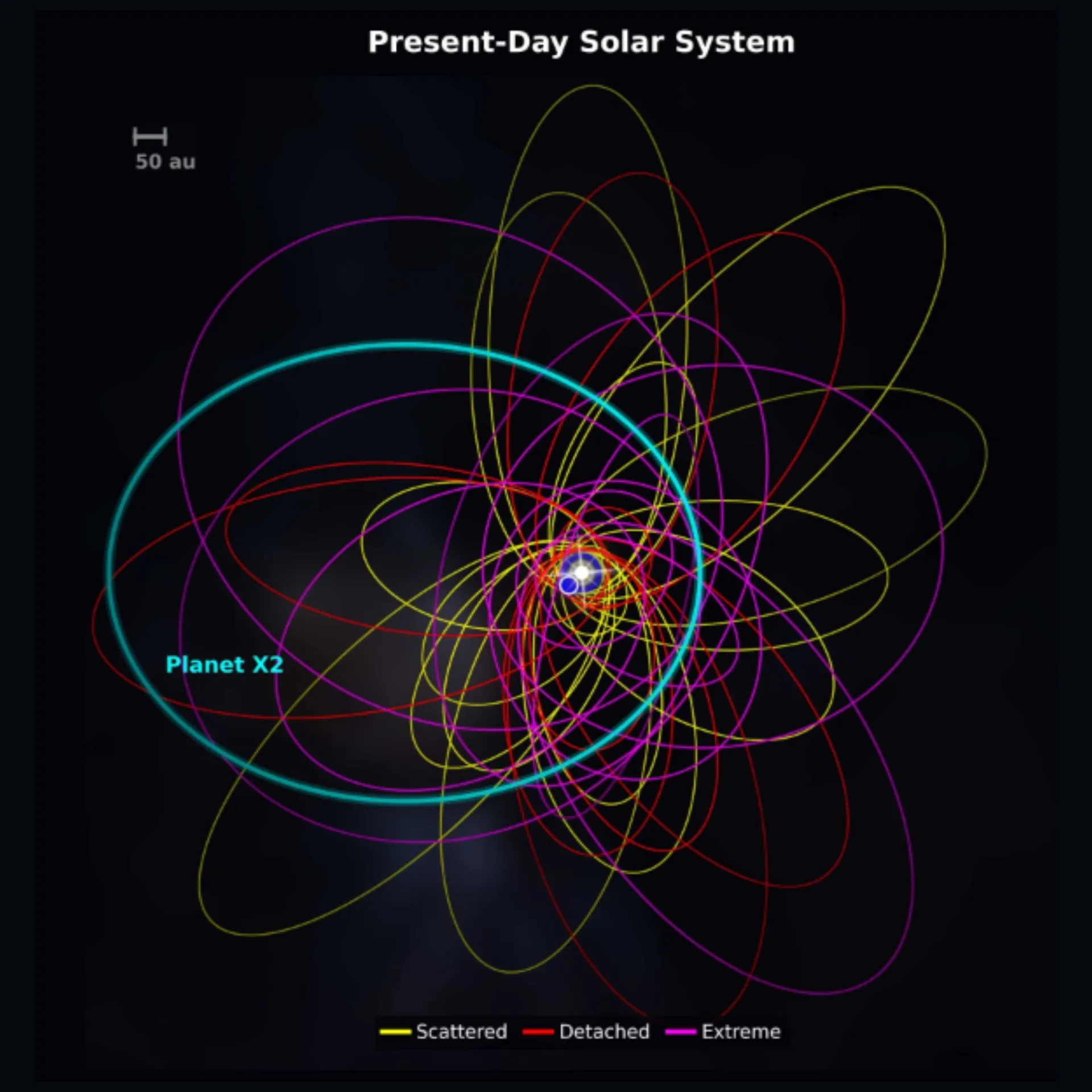
Patrick Likafka, an astronomer at Kinki University in Japan, teamed up with Pedro Bernardinelli of the University of Washington and Jonathan Horner of the University of Southern Queensland to simulate the evolution of the solar system over the past 4.5 billion years. They hope to find out whether there is an undiscovered planet beyond the known planets, which is enough to cause the "disorder" of the distribution of icy objects beyond Neptune.
The research team named this hypothetical object "Planet X2". The name echoes the long-standing "Planet X" research tradition, but is not the same as the previously proposed "Planet Nine" hypothesis. Most Kuiper Belt objects orbit the Sun beyond Neptune, forming a wider disk-like region; while objects further away exhibit more complex orbital characteristics. Some icy objects have orbits with an inclination angle of more than 45 degrees to the plane of known planetary orbits. Others are called "breakaway objects". Even if they reach the closest position to the sun, they are still far away from Neptune and are therefore basically not affected by its gravity. The dwarf planet Sedna is an example. Its closest distance to the sun is more than 76 times the distance between the earth and the sun, far exceeding the orbit of Neptune, which is about 30 times the distance between the sun and the earth.
The simulation results show that to most effectively reproduce the structure of the solar system beyond Neptune, this hypothetical planet X2 should have about twice the mass of the Earth and move along a very narrow orbit; its closest distance to the sun is about 200 times the distance between the sun and the earth. Research believes that over billions of years of evolution, the gravity of this celestial body may have tilted the orbits of some celestial bodies significantly, while allowing other celestial bodies to escape the influence of Neptune's gravity and maintain relatively flat orbits.
Another set of simulations suggests that planets similar in size to Mars or Earth may indeed have stirred up outer celestial bodies in the early solar system, but these smaller planets tend to be ejected from the solar system before leaving a lasting impact. Therefore, if this hypothesis is true, there may indeed be a large celestial body with a mass about twice that of the Earth in the outer reaches of the solar system.
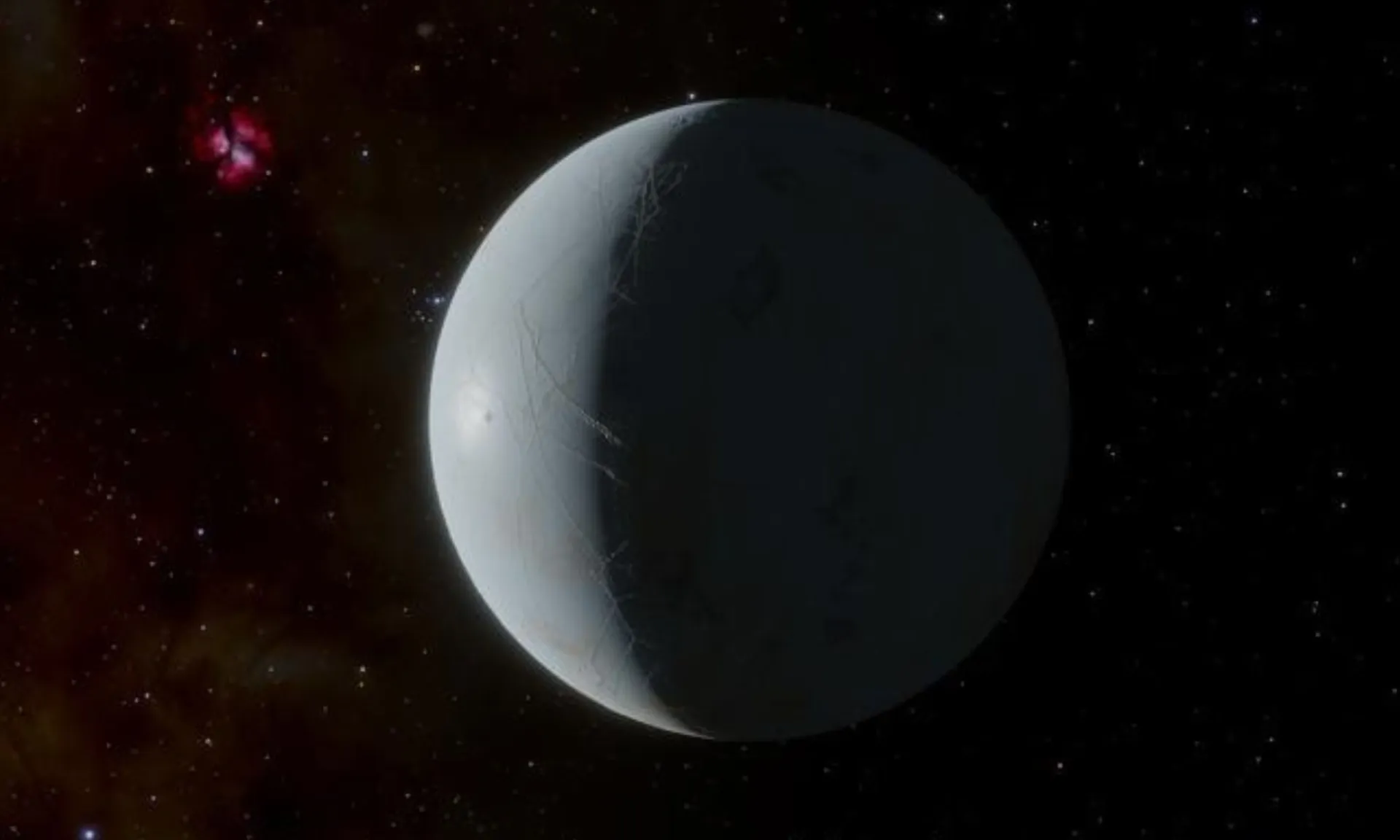
Compared with "Planet 9", Planet X2 is envisioned on a smaller scale. The "Planet Nine" hypothesis mainly attempts to explain why the orbital directions of some extremely distant celestial bodies present similar arrangements. Last year, astronomers using the Subaru Telescope in Hawaii reported the discovery of a Sedna-like object "Ammonite" whose orbit seemed inconsistent with surrounding celestial bodies. Other studies have suggested that if a star passed nearby when the sun was young, it might have pushed some celestial bodies into orbits similar to Sedna.
The research team emphasized that the simulation results do not equal the discovery of new planets. "Chaos" in the outer solar system can be caused by a variety of mechanisms, so even if the observed characteristics are consistent with the possible impact of a hidden planet, it cannot be concluded that it actually exists.
This new model still needs further improvement. The research team conducted simulations based on data from the Dark Energy Survey project and found that the better model could more reasonably match the orbital inclination angles of peripheral objects and their closest distances to the sun. However, within the larger orbital scale range tested, the number of detectable objects given by the simulation was too small.
However, scientists still have reasons to be optimistic. Distant rocky or icy objects may still appear in areas of the sky that humans have observed for decades. Recently, Chile's Vera Rubin Observatory discovered an icy object tentatively named 2026 ED138 in early observation data. It is large enough to be classified as a dwarf planet, which also shows that there are still many unknown celestial bodies on the edge of the solar system waiting to be discovered.
The Rubin Observatory will carry out a ten-year sky survey and repeatedly photograph the southern sky, which is expected to provide opportunities to search for such distant celestial objects. To directly discover Planet X2, astronomers would need to capture the faint sunlight reflected from it and track its movement in multiple images.
Even if the planet remains shrouded in darkness, the hypothesis might still be tested in another way. If the model is correct, future sky surveys should be able to discover a number of objects that are far away from Neptune and have relatively small orbital inclinations. The research paper has been published in Monthly Notices of the Royal Astronomical Society.
Comments