
Abstract:
A Northwestern University research team has developed a new nanomaterial inspired by natural melanin, which is expected to provide additional protection for people exposed to harmful organophosphorus chemicals for a long time. This technology is expected to be used in soldier combat equipment, agricultural protective equipment and industrial safety equipment in the future to help reduce the health risks caused by nerve agents and some pesticides.
The material developed by the researchers is called "Allomelanin", and its design is inspired by melanin in nature. Melanin not only gives organisms their color, but also has the ability to adsorb and process a variety of chemicals. The research team hopes to use this natural property to build protective materials that can actively capture and degrade hazardous chemicals.
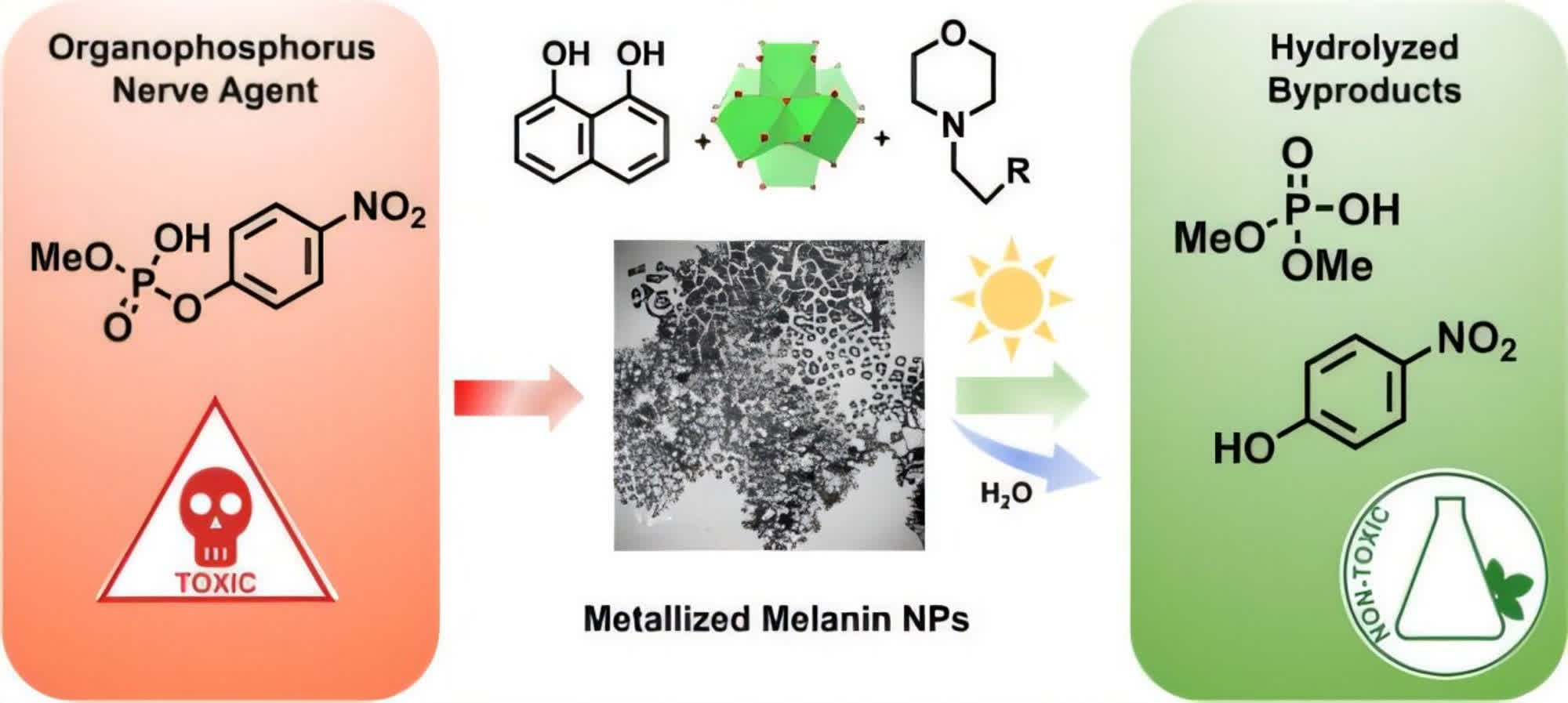
This study, published in the journal ACS Nano, focuses on organophosphorus compounds. Organophosphorus compounds are widely used in the manufacture of pesticides, insecticides, and nerve agents. Among them, nerve agents can disrupt normal signal transmission in the human nervous system. In severe cases, they can lead to loss of control of respiratory system and heart function, and even be life-threatening.
The research team introduced zirconium clusters based on the porous structure of isomelanin, allowing it to have dual functions of adsorption and catalysis. The isomelanin in the material is responsible for capturing harmful chemical molecules, while the zirconium element is responsible for promoting the decomposition reaction, thereby reducing toxicity and accelerating the deactivation of harmful substances.
In order to improve the practical application value, the researchers further modified the material so that it can automatically form an environment suitable for chemical degradation reactions after contact with moisture. Experimental results show that after exposure to nerve agent simulants, the levels of toxic by-products can be reduced by approximately 50% in just 10 minutes. Research shows that light conditions can further enhance its degradation effect.
Unlike many protective materials, this new type of melanin material is renewable and biodegradable while having low toxicity. The researchers said that the material can be embedded into fibers and fabrics as a pigment or additive, so it is expected to be directly applied to protective clothing, tactical equipment, gas masks, gloves and other products.
The research team envisions that in the future, protective gloves and masks used by farmers, as well as combat uniforms and personal protective equipment used by the military, can all be added with this nanomaterial. In the event of a chemical contamination incident, contaminated clothing can also be quickly treated by spraying an aqueous solution containing relevant compounds to reduce the threat posed by harmful substances.
Researchers pointed out that the technology is still in the laboratory verification stage and is still some way away from large-scale commercial application. In the future, it is necessary to further evaluate the stability and cost performance of materials under long-term use, repeated cleaning, complex environmental exposure, and large-scale manufacturing conditions. However, this research demonstrates a new way of using bionic nanotechnology to proactively deal with hazardous chemicals, and also provides a new direction for the development of the next generation of personal protective equipment.
Comments