
Abstract:
The "Optimal Transit" maritime technology alliance, jointly formed by offshore engineering company InMar Technologies and energy system developer OptiFuel Systems, recently announced a large-scale offshore infrastructure concept platform called "Blue Economy VITAL 100 MW Kraaken".
The plan integrates offshore power generation equipment, desalination facilities and artificial intelligence data centers into a ship with autonomous navigation capabilities. It claims that it does not require land resources, does not rely on land power grids, and does not require the consumption of traditional fossil fuels in routine operations.
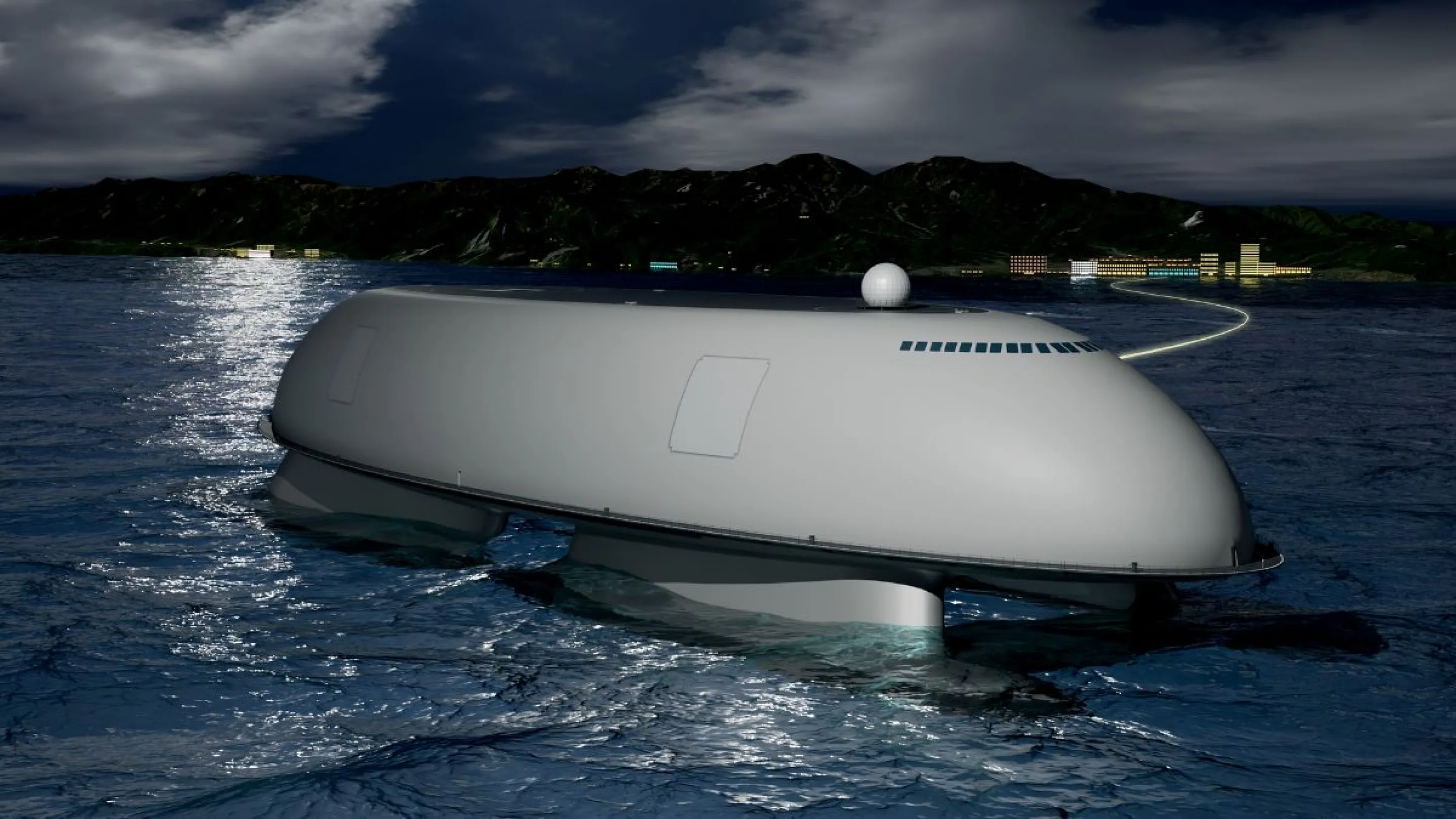
According to specifications published by the project party, the multi-purpose ship is designed to have a total power generation capacity of 100 megawatts. Under the "VITAL" configuration, the entire ship's power will be comprehensively deployed: 40 MW of power will be continuously transmitted to the land through submarine umbilical cables, which is enough to meet the around-the-clock power needs of about 32,000 households; the ship's fresh water system can use vacuum flash technology to produce 30 million liters (approximately 7.9 million gallons) of fresh water per day, which can supply daily water for about 150,000 people; the remaining 60 MW capacity is specifically used to support the ship's high-density AI computing cluster. This solution is an upgrade and evolution of the offshore floating data center launched by the project team in July this year (originally planned to have multiple versions of 10 to 100 MW). While maintaining the original power system, hull and mooring design, part of the computing power will be transferred to utility support for coastal residential areas or disaster areas.
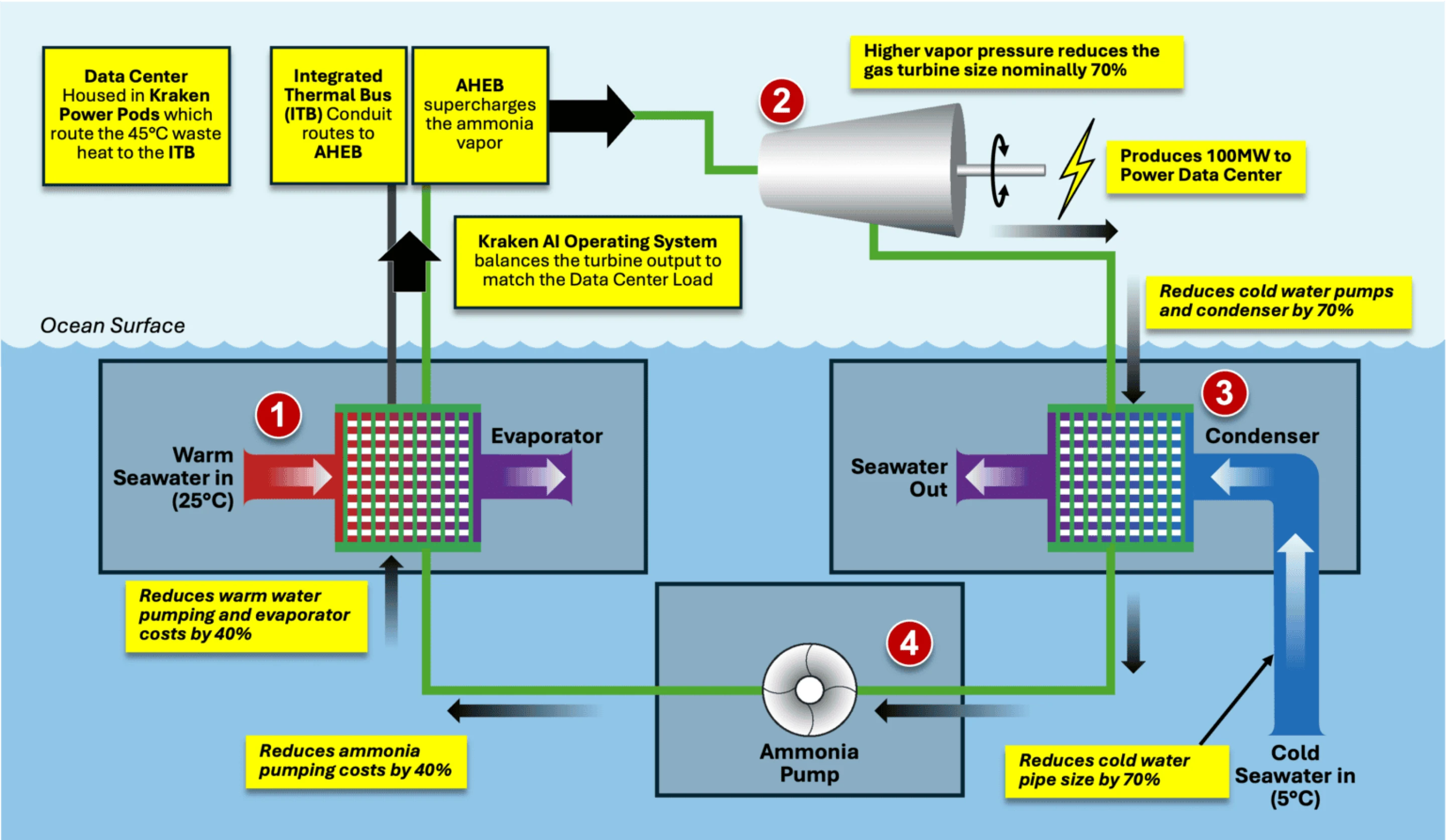
The core power of Kraken relies on its patented "Digital Ocean Temperature Difference" (DOT) engine, which is a major improvement over traditional Ocean Temperature Difference Energy Conversion (OTEC) technology. Conventional OTEC systems vaporize low-boiling-point working fluids (such as ammonia) through warm tropical surface seawater to drive turbines to generate electricity, and then use cold water extracted from the deep sea to condense the working fluids to form a cycle. What is different from the past is that Kraken connects the waste heat (about 45 degrees Celsius) generated by the liquid-cooled servers on the ship to the circulation system to reheat and pressurize the ammonia gas before entering the turbine turbine; then, deep seawater from 5 degrees Celsius recovers the waste gas in the condenser. Relying on server waste heat recovery, multi-stage Rankine cycle and enthalpy recovery technology, the developers claim that the system can reduce the size of the turbine by about 70%, and the size of the cold water pipeline and the load of the cold water pump can also be reduced by 70%, thus significantly reducing the physical threshold for cold water extraction in traditional ocean temperature difference power generation projects. At the same time, this thermal cycle is matched with low-pressure vacuum flash technology to use hot and cold fluids to collaboratively achieve seawater desalination and self-condensation, forming a trinity closed loop of "power generation-computing power-water production".
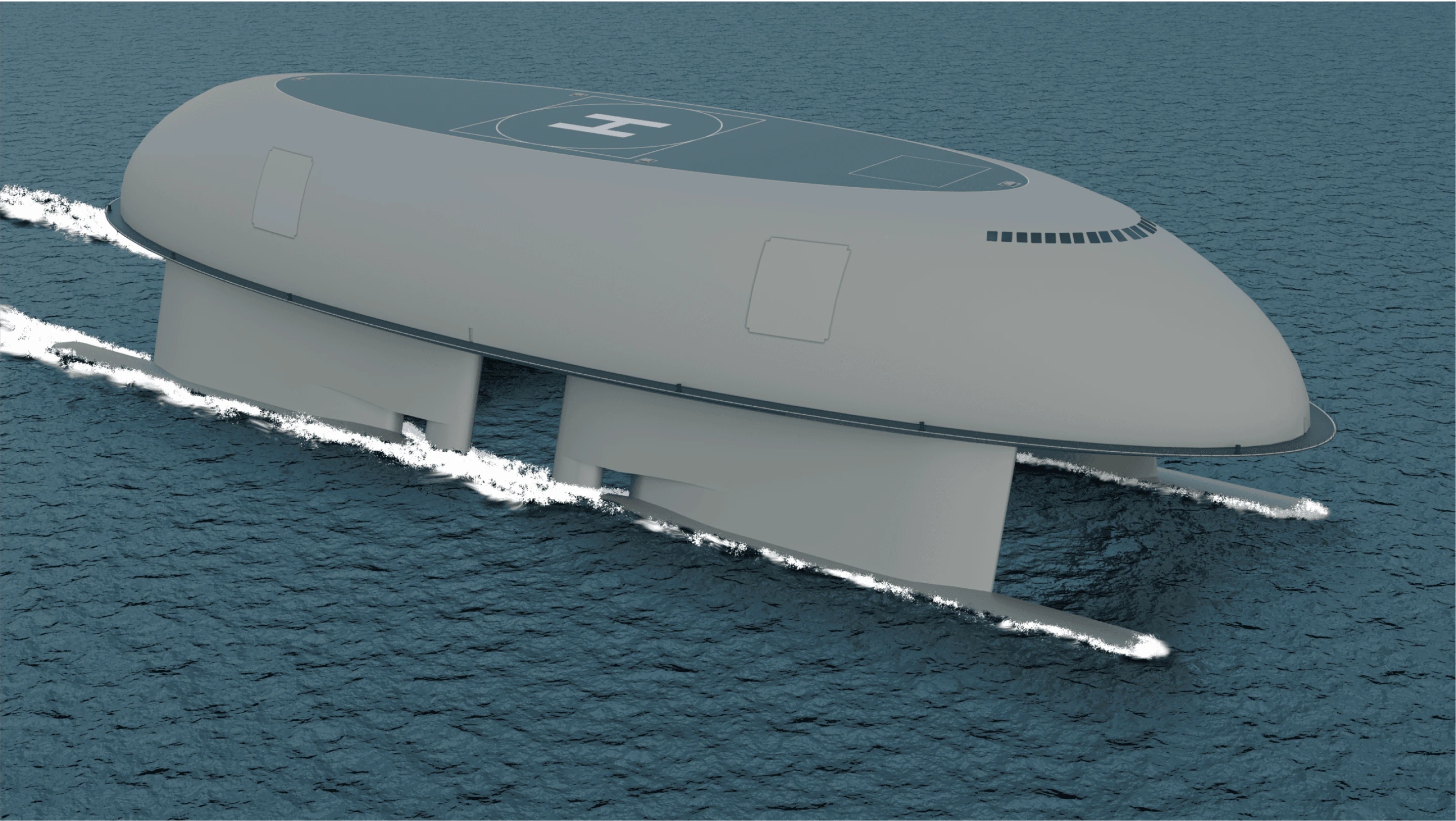
In terms of hull engineering, Kraken uses a Small Waterplane Area Catamaran (SWATH) design, which is approximately 91 meters (300 feet) long and has a displacement of approximately 50,000 long tons. By placing the main buoyancy structure in the deep water area where waves are less swaying, the hull achieves extremely high stability for offshore operations. The onboard data center hardware adopts a modular liquid-cooling design, which facilitates timely disassembly and upgrade according to the iteration of computing hardware. When deployed near the coast, the ship is connected to the land pipeline network through a quick-detachable umbilical system; if threatened by a hurricane or extreme storm, the ship can break away from its mooring within a few hours, drive to a safe sea area at a maximum speed of nearly 16 knots, and then return to the site for reset after the storm. This high mobility allows it to not only serve remote islands or coastal industrial areas, but also serve as an emergency lifeline when natural disasters occur. The project team even envisions assembling 5 such ships within 3 square kilometers of sea area to create an "offshore sovereign energy park" with a total output of 200 megawatts of electricity, 151 million liters of fresh water, and 300 megawatts of computing power.
Cost estimates show that the total cost of building a complete 100 MW VITAL vessel is estimated at $587 million. The project party pointed out that if a 40-megawatt power plant, a 30-million-liter-per-day seawater desalination plant, and a 60-megawatt AI data center computer room of the same magnitude were built on land, the total investment would be US$750 million to US$1.33 billion; the offshore integrated solution can save about 22% to 56% of construction funds and compress the delivery period from 6 to 10 years for land infrastructure to about 3 years.
Despite the promising concept, the project faces a lot of practical scrutiny when it comes to construction. First of all, the project is still in the scheme design and digital twin verification stages. The Series A financing is only used to complete engineering drawings that comply with classification society specifications. The shipbuilding schedule depends on the planned Series B financing in 2027. There is no ready-made entity at sea. Second, a net output of 100 MW is an unprecedented engineering volume for ocean thermoelectric energy. The theoretical efficiency of traditional OTEC is usually less than 4%, and processing hundreds of megawatts of power usually requires pumping tens of billions of liters of seawater per day and suspending a huge cold water pipe that extends thousands of meters underwater and is several meters in diameter. Although the DOT system claims to be able to reduce pipe diameter, detailed data on the physical connection and fatigue resistance of deep-sea water intake pipelines during ship emergency escape and reset have not yet been released. In addition, 40 MW of external power supply and 60 MW of computing load have fully occupied the theoretical installed capacity, and the precise energy balance sheet of its own power consumption, such as fresh water vacuum pumps and cold seawater pumping, still needs to be publicly verified; The claim that the ship can operate in sea areas that lack significant vertical temperature differences, such as the Arctic, is also inconsistent with the geographical requirements of traditional thermodynamics for ocean temperature differences, and there are theoretical details that have not been fully clarified. The industry believes that all aspects of the technology integrated by Kraken have mature physical basis, but whether such high-density thermal and computing facilities can be successfully integrated into a single motorized hull within the budget still needs to be verified by subsequent actual testing.
Comments